
Terahertz imaging & spectroscopy
Layers, defects and material properties
We use terahertz waves to investigate structures beneath the surface of materials. Our work combines time-domain measurements, image reconstruction and physical modelling to study composites, coatings, microelectronic packaging and cultural heritage objects.
In suitable materials, reflections from internal interfaces carry information about layer structure and thickness. Spectral measurements provide complementary information about dielectric properties. The challenge is to recover this information from signals affected by overlapping echoes, attenuation and material anisotropy.
Research in practice
Seeing beneath impact damage
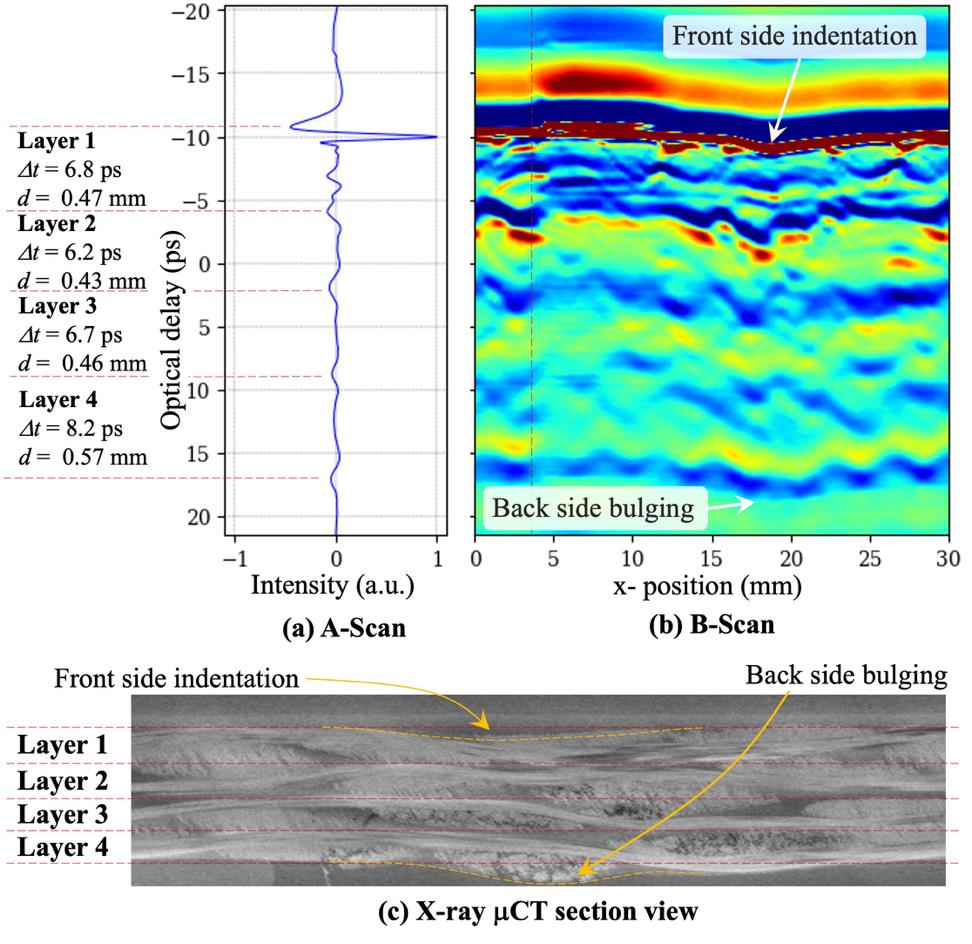
D. J. Silitonga et al., Composites Part B 309, 113033 (2026).Open full-size figure (opens in a new tab)
Composites · Imaging · Machine learning
From depth profiles to damage classification
Impact can change the internal structure of a composite while leaving little visible damage at the surface. Depth-resolved terahertz measurements reveal changes across the laminate.
We compare THz B-scans with X-ray microtomography to identify damage and train automated classification methods. The example shows the four layers of a glass-fibre/polyamide composite, together with deformation on its front and back surfaces.
Group co-authors: Dicky Silitonga · Haolian Shi · David S. Citrin · Alexandre Locquet.
Read the 2026 study →Experimental capabilities
What we can investigate
- Layer structure. Depth profiles and interface reconstruction in suitable coatings, laminates and layered objects, using time-domain reflections and deconvolution.
- Damage and fibre organization. Cross-sectional images and polarization-dependent measurements to investigate impact damage, delaminations and structural changes in composites.
- Material response. Spectral measurements and physical modelling to compare dielectric behaviour and interpret the response of constituent materials.
Our experimental work is part of the laboratory’s Nondestructive Evaluation (NDE) platform, led by Alexandre Locquet, bringing together terahertz imaging, ultrasonics and acoustic microscopy.
Feasibility depends on the material’s absorption, surface geometry and contrast between interfaces. Closely spaced interfaces can produce overlapping echoes. Sample composition, dimensions and the feature to be resolved help us assess a suitable approach.
Discuss a sample or measurement →Research themes
From the measured signal to the material
Composites and internal damage
We investigate impact damage, delaminations and the internal woven structure of fibre-reinforced polymers. Terahertz images and polarization-dependent measurements help relate the measured response to fibre orientation, deformation and subsurface features.
Read the composite study →Coatings and microelectronic packaging
Our studies address conformal-coating thickness, mill-scale layers on steel and multilayer packaging structures. We also characterize glass-based materials and polymer composites relevant to high-frequency microelectronics, including 6G packaging.
Read the coating study →Cultural heritage and layered objects
We investigate the stratigraphy of paintings, paper stacks and other heritage materials. Reconstructing interfaces and subsurface features can contribute to understanding how an object was made, altered or restored, in collaboration with heritage scientists and conservators.
Explore our open dataset →Reconstruction and material characterization
We develop and evaluate deconvolution, polarization-resolved analysis and data-driven methods for interpreting terahertz measurements. Complementary measurements, including ultrasonic and acoustic microscopy studies, support material characterization and comparisons between techniques.
Read the reconstruction review →Open data · 2026
Reading text on both sides of a page
Our published terahertz reflectivity dataset contains measurements of patterned paper sheets with toner, inkjet ink, iron gall ink and graphite. It provides labelled time-domain signals for classifying markings on the front, back, both sides or neither side of a sheet.
This work was carried out in collaboration with Cédric Pradalier.
The accompanying Data in Brief article describes the measurements and a machine-learning baseline. The data are available through Recherche Data Gouv.
Related project
UNVEIL: nondestructive evaluation for cultural heritage
The UNVEIL doctoral network connects nondestructive imaging, heritage science and digital tools. The group contributes terahertz research and coordinates the network at Georgia Tech–CNRS.
Visit the UNVEIL project websiteSelected publications
Methods and applications
- Automated classification of subsurface impact damage in thermoplastic composites using depth-resolved terahertz imaging and deep learning
D. J. Silitonga et al. · Composites Part B: Engineering 309, 113033 (2026). - Sparse virtual wave thermography for nondestructive evaluation using orthogonal matching pursuit
H. Shi et al. · NDT & E International 164, 103805 (2026). - Stratigraphic reconstruction from terahertz and ultrasonic signals by deconvolution: A review
R. Zito et al. · NDT & E International 158, 103524 (2026).